On Space
Edition II:
Not every meaningful place announces itself. Some of them only appear after you've stood there long enough.
There's a difference between the places we use and the places that slowly begin to hold us.
Most spaces in daily life are built for function: pass through, complete the task, move on. Occasionally a smaller space forms inside the larger one. It's not separate or isolated, just different.
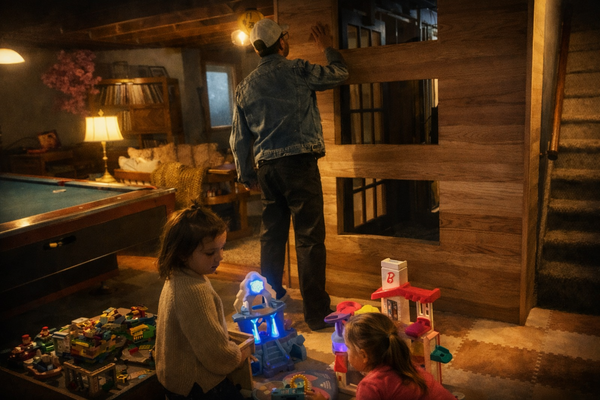
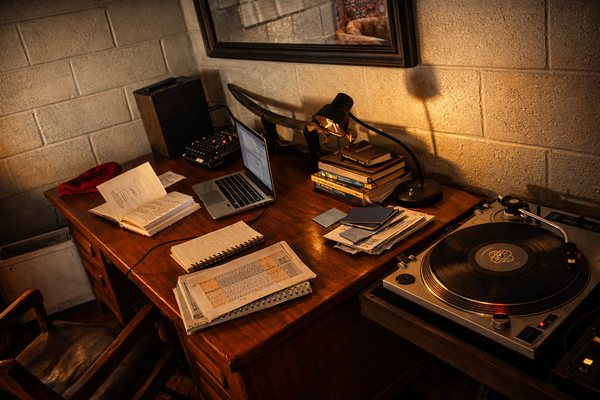
It's the corner of a room that slowly becomes yours like the edge of the garage workbench, a corner of the garage, or sometimes the whole damn garage itself. A section of the basement you didn't plan to claim but kept returning to. A chair that ends up facing the right direction. Part of the yard where you stand a little longer than necessary. The balcony rail you lean on at the same hour without deciding to. Sometimes it's nothing more than a table cleared just enough to sit at.
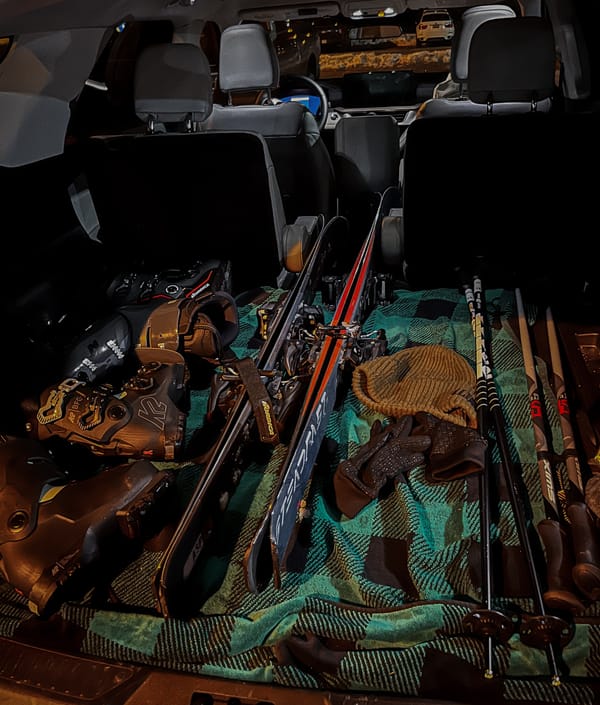
Then the boundary widens. A familiar seat in a cafe where conversation softens. A stretch of park bench that turns waiting into staying. The parked car before going inside or a drive that isn't about arriving. The first minutes beside a lake, river, or shoreline, before you reach for your phone. The walk between two obligations that unexpectedly becomes its own destination.
There's also the vibe. It's not an aesthetic or decorations, but more like a quiet agreement between you and the place: a certain light at a certain hour, the way the air sounds when nothing is being rushed, objects arranged just enough that you don't have to decide how to begin. You don't analyze it, but you notice when it's right, and you notice immediately when it isn't.
The vibe doesn't force attention. It gives attention somewhere to land.
It works best when the space isn't trying to impress anyone. Most environments are arranged for presentation: tidied for visitors, optimized for photos, set up to look right even when no one is living in them. A space within the space doesn't need to do that. It only needs to make sense to you. Things can stay where they were last used. The arrangements reflect the habit instead of display.
When a place stops performing and starts belonging, you stop performing inside it too.
Different places, same phenomenon; not escape or retreat, but a location where attention settles. Over time you begin to recognize it as a kind of Realm; not a separate world, just a condition that appears inside the ordinary once you agree to inhabit it fully.
Once attention settles, hands follow. You adjust something, wipe something down, open a notebook, tune, cut, sweep, pour, or sketch. The space doesn't demand productivity, it invites participation. This is where interests turn into practices, and practices into craft.
These spaces become many things all at once:
- Sometimes solitude, or a place to reset.
- Sometimes presence, or a place to return.
- Sometimes community, or a place shared without performance.
Mostly importantly, these spaces become a place where interests turn into actions.
Craft rarely begins with ambition. It begins with a surface that invites touch and enough quiet to notice that you want to respond. The space doesn't limit you. It makes possibilities visible. Over time you start recognizing them before they fully form: the conditions, light, distance, permission, edges, and time that isn't being negotiated.
You don't build the space to escape life. You build it so life can be entered more deliberately.
A note
These three entries belong together:
- On Presence concerns attention.
- On Space concerns where attention can live.
- On Integration concerns how it survives the rest of life.
Everything that follows builds outward from here as orientation.