The Cost of Being Present
Presence slows time and deepens life, but its real lesson is learning how to go deep without disappearing from the people and responsibilities that give life meaning.
Edition II:
Presence Begins with Attention
Some forms of absence look exactly like dedication.
For a while, I thought I was getting pretty damn good at being present. I could disappear into a project for hours. Building something in the basement, working on a room, messing around with music, or whatever had me at the time. I wasn’t scrolling through my phone or thinking about ten other things. I was completely there. By most definitions, that sounds like presence.
The problem was that my loved ones might have had a different definition.
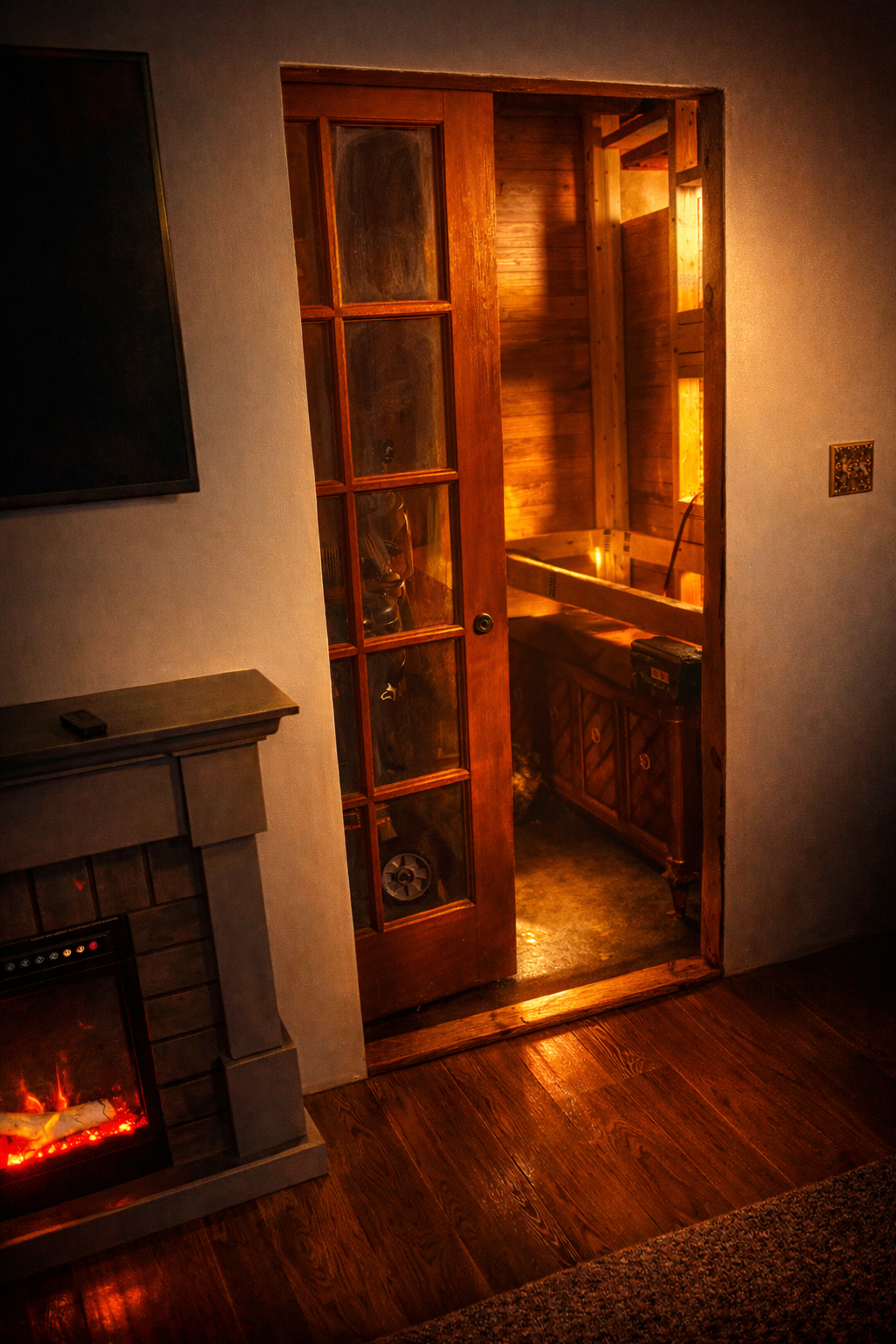
I started noticing that some of the moments when I felt most present were also the moments when I was least available to everyone around me. I could spend three hours completely absorbed in something down in the basement and walk upstairs feeling restored, maybe even proud of myself for having spent the day actually doing something. Meanwhile, I’d essentially been gone. Apparently being twenty feet away in the basement does not automatically qualify as being present with your family.
That’s where my definition started getting more complicated. There is something incredibly valuable about going balls deep into something. Craft almost demands it. Try building, making art, or learning an instrument while giving it twelve percent of your attention and see what you end up with. That kind of absorption taught me what sustained attention actually felt like.
But it also exposed the part I had missed.
Presence isn’t only about what I give my attention to. It’s also about being accountable for what my attention withdraws from.
Learning to Hold Attention
Before I stopped drinking, I spent an incredible amount of time living somewhere slightly ahead of myself. When is the next opportunity to drink? Where are we partying this weekend? Who are we getting together with? What are we doing, and more importantly, does that activity provide a reasonable excuse to get hammered?
There was always a what’s next? running in the background. Even when something good was happening, part of me was already leaning toward whatever came after it. A dinner could become the thing before the bar. A Saturday afternoon was the thing before Saturday night. An entire week could become the waiting room for the weekend. I don’t think I understood how much of my life I was experiencing as a prelude to something else.
When I stopped drinking, that machinery suddenly had nothing to organize itself around. Sobriety from alcohol didn’t immediately replace it with some enlightened state of presence. Mostly, there was just a lot more room. Nights were longer. Weekends were different. And for the first time in a long time, I had to figure out what to do with the hours themselves rather than constantly pointing them toward the next opportunity to get fucked up.
I started filling that space by doing things. Building, drawing, working on rooms, making music, learning whatever strange thing had captured my attention that month. Somewhere in there, something changed. I could spend hours with a project and realize I hadn’t been waiting for anything else to happen. There was no next destination pulling at the moment. I was already where I wanted to be.
That’s probably where I first understood presence, although I wouldn’t have called it that at the time. It wasn’t meditation or some deliberate practice. I had simply found things capable of holding my attention long enough for me to finally notice the life happening in front of me.
The solitude became powerful. It’s hard to walk away from something that makes time feel generous again.
What We Stop Seeing
It would be easy to treat presence as another form of self-improvement, one more thing to get better at in a culture already obsessed with becoming better versions of ourselves. I’m more interested in what we lose without it.
We have become remarkably good at being somewhere other than where we are. A quiet moment gets filled before it has a chance to become anything. We walk while looking at our phones, watch something while scrolling through something else, eat while thinking about work, work while thinking about the weekend, and spend the weekend wondering what we should do next. Even our attempts to escape can become another itinerary to complete. I know that pattern well. Drinking was simply my most obvious version of it.
The cost is easy to miss because nothing necessarily looks wrong. Life keeps moving. Work gets done. Kids get dropped off. Dinner gets made. Vacations happen. But entire stretches of life can pass while our attention is perpetually pointed somewhere else. And if attention determines what we actually experience, then presence isn’t really about becoming calmer or more mindful. It’s about being around for your own life.
Rather than some eternal state of enlightenment, I was beginning to recover the ability to stay with a place, a person, an interest, or an ordinary Tuesday long enough for it to become something more than the space between other things.
The Hidden Cost of Immersion
The problem was that presence didn’t come with an off switch.
When attention deepened, work didn’t politely stay in its lane. It followed me into the evening, into conversations, and into moments that probably deserved more of me than whatever I was still turning over in my head. What felt like depth on the inside sometimes looked like absence from the outside. I didn’t vanish dramatically. I just wasn’t fully there.
This was the part I hadn’t accounted for. Being fully absorbed in something feels great when you’re the one inside of it. It can feel very different to the people waiting for you to come back out. The deeper I went, the easier it became to justify staying there a little longer. One more hour, one more task, one more thing to figure out. Eventually something has to push back, and usually it isn’t the project. It’s dinner, bedtime, a conversation with my wife, or one of the hundred ordinary responsibilities that don’t stop existing just because I’ve found something more interesting to do.
We live in a culture that praises focus without asking where it’s applied or who absorbs the cost. Busyness passes for commitment and unavailability reads as importance. No one asks where the attention went, only what it produced. Depth is celebrated. Boundaries are assumed.
Depth requires withdrawal.
Life requires participation.
Most of us are taught to choose.
When Presence Drifts Away
Presence usually doesn’t disappear in some dramatic way. I don’t wake up one morning and realize I’ve completely lost touch with my own life. It happens slowly as work gets busy, the calendar fills up, I start thinking about three projects at once, and my phone gets checked a little more often. There’s always something I should be doing, and somehow I can spend an entire day doing things without feeling like I was really there for any of it.
I’ve gotten better at recognizing that feeling. I get restless and little things annoy me more than they should. I start bouncing between tasks and thinking about the next thing before I’ve finished the one in front of me. Usually the answer isn’t to try harder at being present. If anything, turning presence into another item on the long list of shit I need to accomplish probably makes it worse.
What does help is giving my attention somewhere obvious to go. Sometimes that’s one of my many projects in the basement and other times it’s a walk, a book, or some other pursuit that occupies my brain long enough to stop reaching for the next thing. The specifics matter less than having some kind of boundary around the moment. A place, activity, or stretch of time where I can stop negotiating with everything else for a while. I’ve learned that I can’t force presence, but I can get pretty good at creating the conditions where it tends to show up.
Going Deep Without Disappearing
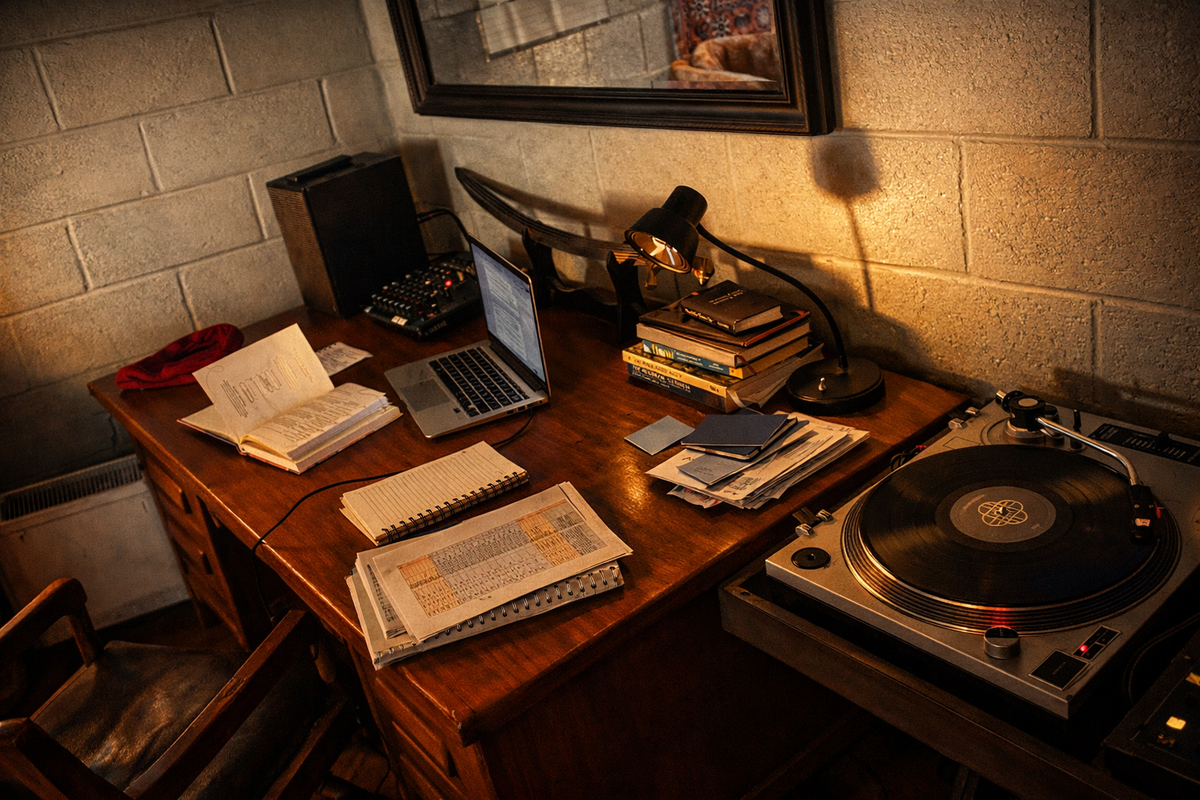
For me, the easiest place to find this kind of attention is usually alone. Give me a basement, a project, some music, and a few uninterrupted hours and I can go pretty damn deep. I need that solitude. I think most of us need some version of it. The problem is that once I’m there, I’m not always particularly interested in coming back out.
That’s the line I’m still learning to recognize. Solitude can reset me, give my attention somewhere to land, and make the rest of life feel sharper when I return to it. Unfortunately, it can also become another hiding place. I’ve already spent enough of my life finding creative ways to be somewhere other than where I actually am.
I don’t want to give up the deep dives. I want the basement projects, the strange interests, the hours spent making something, learning something, or following an idea much further than it probably needed to go. That intensity is part of what makes life interesting to me. I just don’t want the people most important to me to be always waiting on the other side of it.
Maybe that’s what presence has become for me. Not simply learning how to disappear into a moment, but learning when to come back out of one.
I spent years living for whatever came next. I don’t want to make the opposite mistake now and become so absorbed in what’s in front of me that I miss everything happening around it.
The point was never to escape my life more effectively. It was to finally be here for it.
Read Next Article
 David Miga