Optimization: Use It Don't Become It
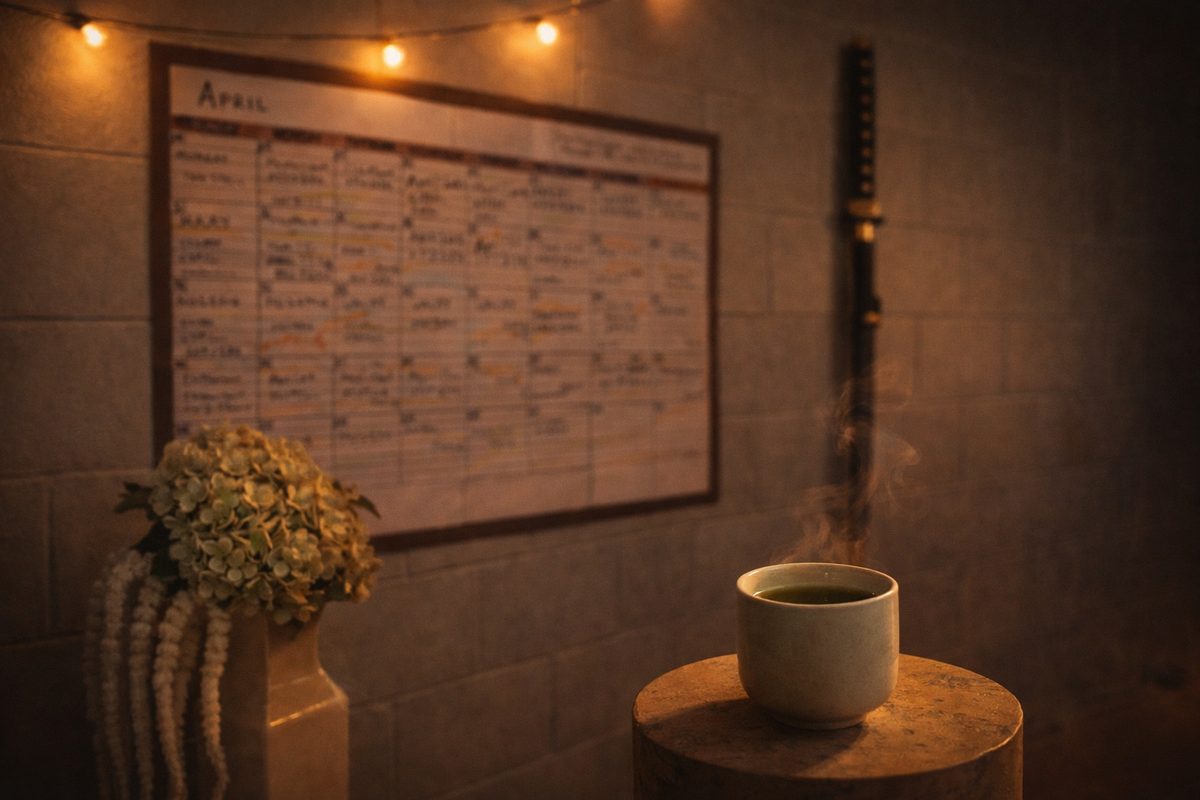
On optimization, discipline, and choosing what not to chase.
Edition VII:
There was a period when I tried to account for all 168 hours in a week.
The idea made sense to me at the time. My career had gotten busier, fatherhood had begun, and time suddenly felt like a resource I could no longer take for granted. I still wanted to work on things of my own, and at that point my interests hadn’t even multiplied into what they are today. I was looking for enough time to build retaining walla. put in a vegetable garden, work out, spend time alone with my wife, or see friends whose schedules had become just as complicated as mine.
None of those things was particularly extravagant. They were simply the parts of life that didn’t have anyone standing over them making sure they happened.
Work had deadlines. Parenthood had immediate needs. A house generated its own list of responsibilities. But the things that filled my cup were easier to postpone. So were friendships, exercise, projects, and sometimes even uninterrupted time with my wife. They mattered, but they rarely arrived with the same urgency.
Optimization seemed like a reasonable answer. Maybe the time was already there and I just wasn’t using it well enough.
So I started thinking about the week hour by hour. If I could understand my routines, identify the gaps and arrange everything properly, perhaps I could make all of it fit.
The problem was that I had designed a week for a life that didn’t exist.
My work schedule changes and requires frequent and unanticipated travel. Family needs shift. Something around the house breaks. An unexpected obligation appears. Energy changes. Interests change. A project that mattered enormously one week might barely register the next because my attention has moved somewhere else.
There were always gaps between the week I had planned and the week I was actually living. For a while, I treated those gaps as failures of execution. Eventually I began to wonder if the problem was the assumption underneath the whole thing.
Maybe life wasn’t supposed to cooperate with the spreadsheet.
The Cost of Improving Everything
Optimization is attractive because a lot of it genuinely works. Structure can help us exercise more consistently, spend less money, sleep better, get more work done and follow through on things that otherwise remain intentions. There is nothing inherently wrong with tracking something, creating a routine or becoming more disciplined. I’ve benefited from all of those things.
The problem begins when improvement becomes the default response to every part of life. There is almost always another variable available to optimize. We can track calories, weight, sleep, steps, workouts, spending, savings, productivity, screen time and habits. We can improve our morning routines and evening routines. We can make better use of weekends. We can become more efficient at work so we have more time outside of it.
Taken individually, many of those things are perfectly reasonable. Taken together, they can become another full-time job.
What’s often rarely discussed is how optimization consumes resources too. Tracking every dollar, every calorie, and a carefully structured routine all require attention. Even deciding how to make better use of your time ironically requires some of that time.
Eventually there is a strange possibility that the effort required to optimize a life begins consuming the bandwidth you were trying to free up.
I’ve found myself increasingly willing to leave some things at good enough. My finances could be more optimized. I know that. There are times when they need more attention, and I give it to them. But I don’t want to track every dollar simply because I could squeeze more efficiency out of the system.
My health is similar. I pay attention to my weight and my strength. I notice how my clothes fit and how I feel. If things start moving in a direction I don’t like, I’ll adjust what I’m eating or increase my activity levels. Could I track every calorie, follow a more exact training plan and chase some ideal physical state? Absolutely. But I don’t really want to.
That isn’t because health or finances aren’t important. They’re arguably two of the most consequential areas of life. Taking either one toward its theoretical maximum would demand time and mental energy from somewhere else. I have to decide whether the additional return is worth what it would displace.
That’s the part of optimization I’ve become more interested in.
What deserves the effort required to improve it?
Discipline Without the Script
I haven’t abandoned structure. I’ve just become less interested in rigid versions of it.
Exercise is probably the clearest example. I want movement to remain part of my life, and I’m willing to hold myself accountable. However, I no longer need every workout to look the same.
Sometimes I run, and other times I walk. Most of the time I do some combination of the two. I might do it in the morning, or I might do it later when the day opens up. When I travel for work, I bring my gym shoes. Maybe I use the hotel gym, but more often I’ll go outside and walk or jog through whatever area I happen to be in. The commitment stays while method moves.
That distinction has become increasingly important to me because flexibility can easily be mistaken for a lack of discipline. I think the opposite can be true. Discipline doesn’t necessarily require forcing the same behavior into every circumstance. Sometimes it means maintaining the intention while being realistic about the circumstances surrounding it.
There is still accountability. I don’t want “being flexible” to become a polite way of making excuses. If movement matters to me, I need to get off my ass. Whether that happens through a prescribed run at a prescribed time matters considerably less than whether I continue returning to it.
That approach leaves room for life without surrendering entirely to it.
This is where I think optimization becomes most useful. Instead of an identity or an endless project of self-improvement, it’s a tool we can pick up when something actually needs help.
What Are We Optimizing For?
The stranger realization for me has been that the things I most want to optimize aren’t necessarily the things we’re usually encouraged to optimize.
I want to get better at finding the slivers of time that let a project move forward. I want enough room to follow an interest when it catches fire. I want time with my wife that isn’t entirely about managing a household. I want to see friends even though coordinating a handful of busy adults can feel like organizing an international summit. I want to make things, learn things and occasionally spend an unreasonable amount of time researching something that has almost no practical value.
In other words, I sometimes want to optimize for fun and interesting shit.
That can sound frivolous because we’ve gotten very good at assigning importance to the measurable parts of adulthood like money, health, career, and responsibilities. When those things absorb every available ounce of attention because they can always be improved further, something else gets pushed toward the margins. Usually it’s the optional stuff.
The painting someone keeps meaning to start. The garden that never gets planted. The old motorcycle or classic car sitting untouched in the garage. The friend we keep saying we should get together with. The instrument we haven’t played in ten years. The Saturday afternoon with absolutely no productive justification behind it.
These things are easy to sacrifice precisely because nobody requires them from us.
Optional and meaningless are not the same thing. That is one of the more useful questions optimization can give us, provided we’re willing to turn it around. Instead of asking only how to improve the areas of life we’ve already been told are important, we can ask what keeps getting crowded out because it isn’t urgent, efficient or particularly practical.
What would happen if some of our discipline went there instead?
Start With the Week You Actually Have
The failure of my 168-hour experiment wasn’t that planning is useless. I still believe in planning. The mistake was starting with an ideal week and expecting my actual life to fit inside it.
I’m more interested now in beginning with reality.
What are the coming days actually asking of me? Who needs me? What responsibilities already have a legitimate claim on my attention? What is happening at work? What is happening at home? How much capacity do I realistically have?
Once those things are acknowledged, where is there still room for something that fills me back up?
On some weeks there might be enough space to disappear into a project for hours. Other weeks I might get twenty minutes. Sometimes exercise happens exactly when I intended it to. Other times the running shoes come out at the end of a long day because the morning disappeared before it started. The mistake is assuming all of those weeks should produce the same result.
This doesn’t mean letting Jesus fully take the wheel. There is a difference between flexibility and passivity. I still want to move things forward, make plans, and create structure when structure is useful.
But I’ve become more willing to go with the flow when the week changes shape, because it always does.
Perhaps the better thing to optimize for is not perfect execution but enough openness to absorb the unexpected. Leave some room for the sideways. Don’t schedule every available inch of your life and then act surprised when reality needs somewhere to go.
That empty space isn’t necessarily wasted capacity.
Sometimes it’s what makes the rest of the week possible.
Use It, Don’t Become It
There is no reason to reject optimization. Used selectively, it can give us more control over where our limited time, energy and attention go. It can help turn intentions into action, and discipline is often what carries something beyond the initial excitement of wanting it.
Keep in mind that optimization is just a tool that doesn’t get to decide what matters. That decision is ours.
Maybe finances or health deserve more attention this month. Perhaps work genuinely needs to consume more of the week for a while. There will be seasons when those things demand more, and pretending otherwise isn’t freedom either. There may also be seasons when good enough really is good enough.
The question I’ve become more interested in isn’t how much more I can squeeze out of myself. It’s what I want the available capacity to be for. If becoming marginally better in one area consumes the time and attention that could have gone toward something that makes life feel larger, that’s a trade worth noticing.
The same question belongs to anyone trying to build a life inside the pressures of work, relationships, family, health, money and everything else life asks us to carry. What are the coming days actually asking of you? What deserves your discipline right now? What can remain good enough? And among all those legitimate responsibilities, is there still some protected space for something that doesn’t need to justify itself beyond the fact that you care about it?
We can’t predict everything that’s going to enter that space. That’s part of the point. A week should have enough structure to hold together and enough openness to change when life does.
Use optimization where it helps. Let it create room rather than consume it.
Use it. Don’t become it.
Kaizoku Path isn't about leaving your life behind. It's about discovering the adventure inside of it.
More Editions, Field Notes, and Project Ledgers can be found at kaizokupath.com