Re-enchanting Ordinary Life Through Living it

What began as a collection of scattered interests became something more coherent through writing. Ikigai helped me recognize the pattern, but Kaizoku Path became the place where I could discover it, express it, and begin turning it into a way of life.
Edition VI:
A Pattern Beneath the Surface
For a long time, the easiest way to explain myself was probably some version of a Renaissance man with too many hobbies.
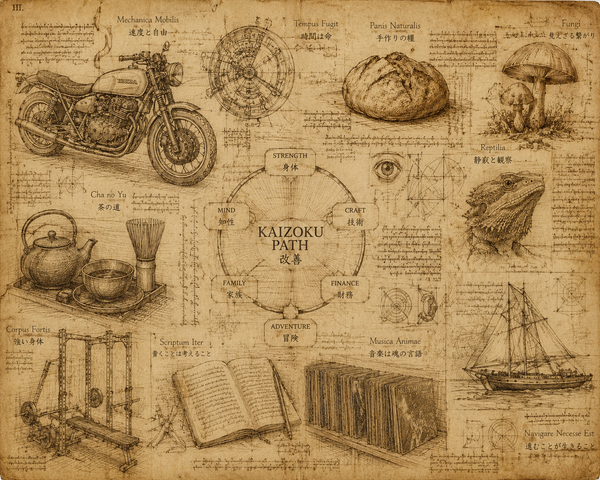
I’ve always moved between interests. Music and audio equipment. Mushroom cultivation and adaptogens. Reptiles and bioactive environments. Bread baking. Drawing. Gardening. Thoughtfully designed spaces. Skiing. Boxing. Travel. More recently, motorcycles and the growing desire to understand the machines themselves rather than simply ride them.
From the outside, I understand how it looks.
Here we go again. David has another hobby. More equipment. Another thing to research. Another project added to the pile before the others are finished.
I’d be lying if I said those reactions never created some insecurity. There’s an expectation that eventually you’re supposed to narrow yourself down. Find your thing. Become good at it. Be practical with your time and money. Having a lot of interests can easily look like an inability to commit.
For a while, “Renaissance man” was a decent enough explanation. I liked a lot of things and enjoyed learning how to do them. But eventually that stopped feeling complete because the number of interests wasn’t really the interesting part. I kept sensing connections between things that, on the surface, had very little to do with each other.
Learning about airflow, filtration and environmental control for mushroom cultivation suddenly gave me knowledge I could apply while designing reptile spaces. Travel changed how I thought about time at home. After experiencing the slower rhythm of Italy, I came back wanting to preserve at least some small piece of it. Before long, I had a little pump-action espresso at the office so I could stop, grind the beans and have an actual espresso moment instead of carrying another drink around while I worked.
Did that transform my American workday into an Italian café? Absolutely not. Most of the time, life here still moves at the speed it moves. But a piece of the experience temporarily survived the trip because I found somewhere for it to live.
The more I noticed connections like these, the harder it became to see my interests as separate hobbies competing for the same limited space.
Around this same period, I encountered the idea of ikigai, a Japanese concept generally associated with the things that give life meaning, value, or a reason to get up in the morning. In the West, it’s often represented by a diagram that attempts to locate purpose at the intersection of what you love, what you’re good at, what the world needs, and what you can be paid for. What interested me was something broader and less concerned with finding one perfect calling.
Ikigai could exist in ordinary life. In relationships, work, interests, responsibilities, things you care for, things you anticipate, and practices you return to. It didn’t have to resolve into one grand purpose. It gave me language for something I had been struggling to explain.
I didn’t need mushroom cultivation, music, bread, reptiles, travel, drawing or motorcycles to individually become my purpose. What mattered was the common thread running through them and my ability to integrate these seemingly unrelated things into a life that felt coherent.
Once I began seeing them that way, something changed. I stopped feeling as though every new interest required me to abandon an old one. I could let them overlap, borrow from one another, disappear for a while and return later. Instead of constantly asking which thing I should choose, I could start asking how they belonged together.
That permission was surprisingly powerful because it let me fucking do it.
The moment I began connecting these things into a single thread was also the moment they started moving forward together.
Eventually, I gave that thread a name.
Kaizoku Path.
Craft
One of the patterns I kept finding was the desire to participate rather than simply consume.
There is something satisfying about making things with my hands, whether that means bread, framing walls, building a reptile enclosure, or cultivating mushrooms. Much of my professional life involves technical problems, travel, schedules, emails and decisions. Physical work pushes back differently.
Wood doesn’t care what I intended to measure. Dough doesn’t care about my schedule. A living environment has actual temperature, humidity and airflow requirements whether my original design accounted for them or not.
Sometimes that means screwing something up. That resistance is part of what I like about it. Participation requires enough attention to notice when reality disagrees with the plan and enough curiosity to figure out why.
The interests also begin feeding each other. When I started learning about mushroom cultivation, I had to understand fresh-air exchange, filtration, humidity and environmental control. Later, when I began thinking seriously about the reptile spaces, some of that knowledge came with me. They are completely different pursuits, but the learning wasn’t wasted when I moved from one to the other.
That has gradually changed how I think about being a person with many interests. I don’t need to become a master of every individual pursuit for the time spent learning it to matter, because knowledge travels.
Curiosity creates branches, and craft gives some of those branches physical form.
Environment
The same thing happens with space.
For a long time, I thought about rooms mostly in terms of what belonged where. As the Basement Incubator developed, I started realizing that environment could do more than contain my interests. It could make participation in them easier.
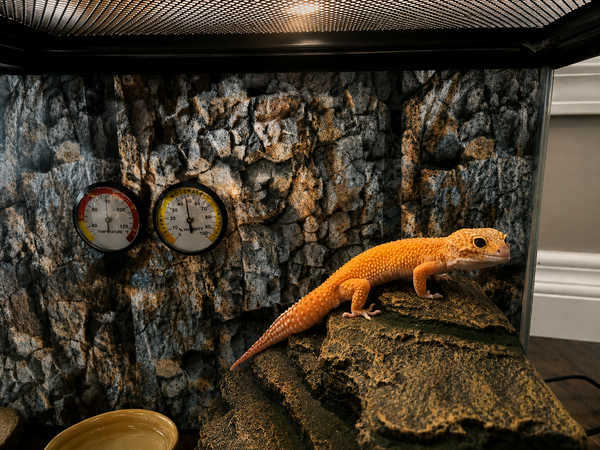
The mushroom work needed somewhere for controlled environments, filtration and clean work. Reptiles required another set of environmental considerations. Music worked better when the records, equipment and places to sit were actually near one another. Tools needed to remain accessible if an idea was ever going to become something beyond a note on my phone.
Instead of finishing one interest completely before allowing myself to begin another, I started planning several of the spaces together. That was a meaningful change. The basement stopped feeling like a collection of hobby rooms and started behaving more like a connected system.
But this idea extends well beyond the basement.
Environment is whatever surrounds a behavior and either encourages it or makes it harder to return to. Sometimes it’s a room or having the right tool within reach. Other times it’s creating a small espresso ritual in the middle of a workday because something you experienced thousands of miles away changed the way you wanted to move through an ordinary afternoon.
A space doesn’t need to be finished to begin doing its job. My own certainly aren’t. Interests go dormant, projects stall, and seasons change what I have time for. At the same time work gets busy and family needs something else from me.
The goal isn’t to create a perfectly optimized environment where every interest receives equal attention. It’s to leave enough room for the important ones to keep finding their way back.
Leaving that room also means accepting that our interests will move in and out of focus. An interest doesn’t have to remain constantly active to keep its place in a life. Some disappear for months before resurfacing, while others gradually become familiar enough that they stop feeling like hobbies at all. Repetition can make things invisible, but it can also deepen them. We notice more, develop preferences, attach memories and begin to recognize meaning in experiences that once seemed ordinary. I’ve become less concerned with maintaining everything at once and more interested in building a life where the things that matter have a way of finding their way back.
What Stays With You
For a while, I thought Kaizoku Path was simply the name I had given this pattern. Then I started writing, which changed the relationship again.
At the moment, Kaizoku Path exists most visibly as an independent publication. I write about skiing, reptiles, bread, spaces, travel, family rituals, drawing, gardening and whatever else manages to pull me far enough down the rabbit hole. On the surface, that could easily recreate the same problem I started with: a pile of unrelated interests.
Instead, the writing has become where I discover and express the connections between them.
Putting something on paper forces me to think about it differently. I have to ask why it mattered, what it connects to, and why I keep returning to it. Sometimes I realize that two interests I thought were unrelated have been teaching me the same thing from different directions. Other times, writing reveals that an idea I’ve been carrying around isn’t really an idea at all until I’m willing to do something with it.
There is also a strange accountability that comes from putting something into words. At work, accountability is built into the structure. There are customers, coworkers, deadlines and people expecting things from me. Family life has its own responsibilities because people I love are counting on me.
Personal pursuits are different. Nobody needs me to build the room, draw the picture, bake the bread, grow the mushroom, learn the machine or take the trip. They’re optional. If I don’t follow through, life continues.
Writing changes that slightly. Once I’ve put an idea down on paper, especially once I’ve shared it publicly, it becomes harder to leave it indefinitely in the category of someday. I’ve stated that this matters to me. Now there’s a small obligation to myself to take that seriously.
That creates a feedback loop I didn’t fully understand when I started. I live something, notice it, and write about it. Writing makes me see connections I hadn’t recognized before. Those connections influence what I build or do next. Then I have something new to live and eventually something new to write about.
Kaizoku Path is more than the writing, but right now writing is where it becomes legible. It’s where a collection of experiences begins to reveal a philosophy and where that philosophy gets tested against an actual life.
Maybe that’s also why ikigai continues to feel relevant to me. I don’t think Kaizoku Path is my ikigai, and I wouldn’t try to redefine the concept around my own experience. What ikigai gave me was another way to understand how meaning can be distributed across a life rather than concentrated in one perfect calling.
For me, that meaning seems to appear in the connections.
It shows up in what I return to, what I’m willing to make room for, what continues to generate curiosity, and what makes me want to participate more deeply without abandoning everything else that matters to me. The satisfaction isn’t necessarily in mastering one thing. Sometimes it comes from realizing that all these seemingly unrelated parts can belong to the same life.
Writing helped reveal that, and Kaizoku Path gave me somewhere to keep exploring it. Perhaps that’s what I hope someone else finds here too. Not my particular collection of interests and certainly not another framework telling them how to live, but permission to take their own curiosities seriously.
There is enormous pressure to be practical, efficient and recognizable. Pick the sensible thing. Use your time wisely. Don’t spend money on another strange interest. Don’t start something unless you know where it’s going.
Sometimes that’s good advice. But sometimes you should fucking do the thing.
Follow the interest, make something, learn the unnecessary skill, build the weird room, and go somewhere because you’re curious about what happens there. Let one thing lead unexpectedly into another and pay attention to what keeps returning. Maybe the pattern becomes obvious. Maybe it doesn’t.
There is something underneath it all, and you may not discover it by standing outside your life trying to solve it.
You may have to live it first. Path.
Kaizoku Path isn't about leaving your life behind. It's about discovering the adventure inside of it.
More Editions, Field Notes, and Project Ledgers can be found at kaizokupath.com