Raising Kids Through Ritual and the Table
A family ritual of travel, culture, and long brunch tables becomes a way of raising children through presence, curiosity, and shared experience.
Field Note II
Raising Kids Through Experience, Not Optimization
We didn’t really set out to create a philosophy around how we raise our girls. Most of what we do with them is an extension of how we lived before they were here.
Within a week of bringing our first daughter home from the hospital, we took her to a restaurant. At four months old, she was on a plane with us to Los Angeles. We didn’t make some declaration that having kids wasn’t going to change us. We just kept going places, eating out, traveling, wandering cities, and doing the things we already enjoyed, except now we brought them with us.
Of course, the logistics changed. Trips include things we know the girls will enjoy, whether that’s Disney World, a playground, a pool, or something chosen specifically for them. But we’ve never really designed an entire trip around the fact that we have children. We still go where we want to go and experience the place in much the same way we would have before. The girls are included in that experience rather than given a separate, kid-friendly version of it.
After seven years of doing this, I’ve started to recognize that something accumulates through that repetition.
There is a particular kind of experience that lingers long after the moment has passed. You find it in small seaside villages in Italy, where nothing is translated for you and you have to pay attention long enough to begin understanding how the place works. You find it on long walks across Chicago, where the city reveals itself block by block instead of as a checklist of destinations.
Food has always been part of it too. Sometimes that means sitting down in front of Taiwanese, Japanese, or deeply regional Italian food that makes no effort to adjust itself to what we already know. We order it anyway. The girls might like it or they might not, but unfamiliarity has never been a reason to avoid something.
At home, Polish runs through the background. “Half na pół,” as we sometimes describe it. English and Polish mix together in conversations, phrases and little exchanges that probably seem completely normal to the girls. Speaking another language has given them an early understanding that their version of the world isn’t the only one. When we eventually took them to Poland, the language they had heard at home suddenly belonged to an entire place, culture and family beyond our own house.
I’ve seen that curiosity carry over. My oldest has a friend whose family is from India, and at seven years old she is genuinely interested in what is different about their culture. I can’t know exactly what experiences will stick or what kind of adults any of this will help them become. What I can do is keep putting them in situations where difference feels interesting rather than threatening.
We aren’t manufacturing enrichment for them. We’re bringing them into a life we genuinely enjoy and allowing them to experience it alongside us.
And somehow, a lot of it eventually comes back to the table.
The Table as Anchor
For us, brunch isn’t just a weekend activity. It has become a family ritual.
We brunch hard.
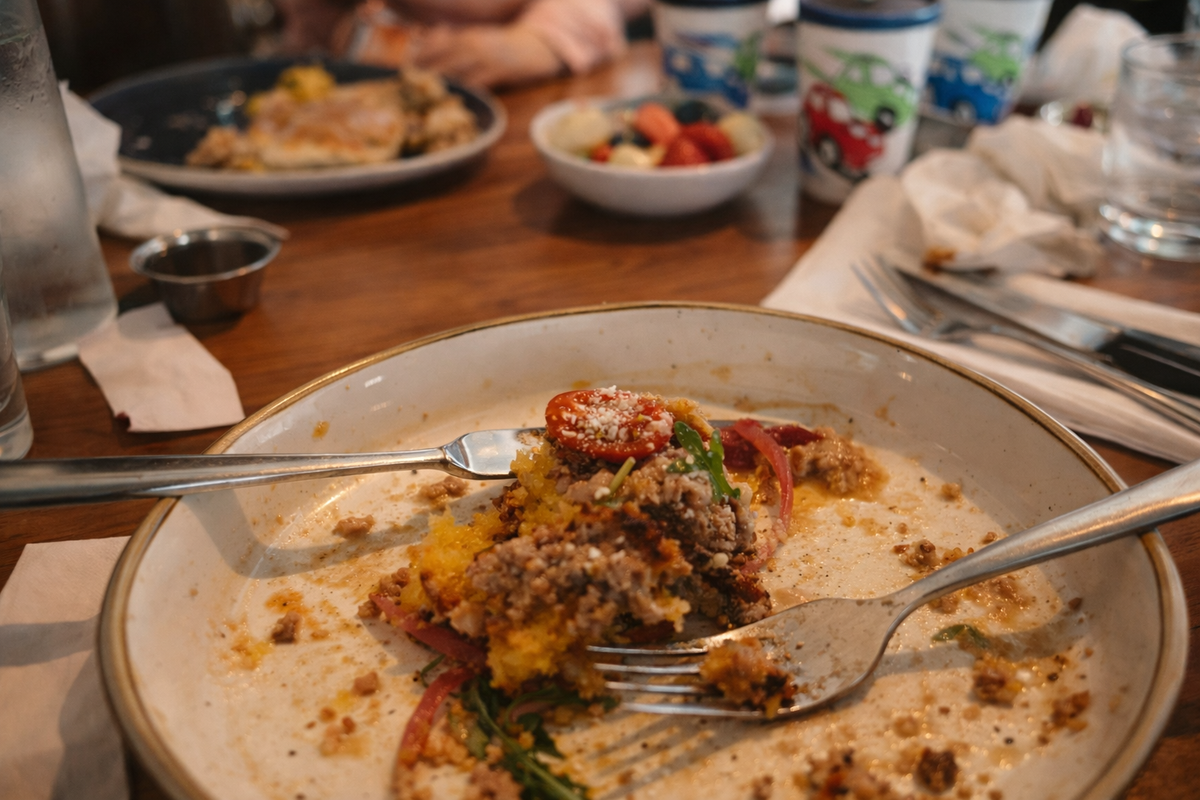
That might mean a ridiculous stack of pancakes, stuffed French toast, or crepes loaded with Nutella, strawberries and bananas for the girls. My wife and I might order eggs Benedict or huevos rancheros and get our coffees. Then everybody starts eating everybody else’s food anyway. Plates move around. We steal some of the sweet stuff. They try ours. We laugh, talk, order too much and generally make an event out of something that could have been finished much faster.
There’s rarely a defined endpoint. That’s part of it.
Travel stories, random thoughts, questions and observations from the week eventually find their way into the conversation. Everything else in their lives shows up there too: books, technology, school, languages, places we’ve visited, something they saw online, something they don’t understand yet.
Sometimes an experience resurfaces long after I would have expected it to. My wife and I had wanted to go whale watching for years, and eventually we did it together as a family in Cabo San Lucas. The girls loved it. More importantly, they still bring it up at the table. The experience ended, but it became part of the family vocabulary.
That’s one of the things I’ve come to appreciate about these long meals. The table is where a lot of what we experience gets another life. Something that happened months ago can suddenly return because a conversation, a food, or a question pulled it back into the room.
To the girls, I doubt any of this feels particularly intentional. It’s just what our family does.
Technology, Attention, and Real Life
Our girls are unquestionably technology natives. They move through devices with an intuition that I certainly didn’t have at their age, and I have mixed feelings about it.
The part that concerns me is attention. I can see how easily a tablet can absorb it and how difficult the transition can be when it’s time to put the device away. There can be resistance and attitude, and I recognize enough about compulsive behavior to take that seriously. These things are extremely good at holding attention.
At the same time, I’m not interested in becoming a Luddite. There is no stopping this train, nor do I think we should try.
I watch my oldest troubleshoot an app that needs an update or figure out that she has to clear storage before something will work. As her reading improves, games that once consisted mostly of pressing buttons begin opening into reading, problem solving and navigating more complicated systems. Minecraft and Roblox can become creative spaces as much as entertainment.
Technology can also create forms of connection I couldn’t have imagined having as a kid. Our girls have cousins in Europe. A nine-hour flight separates them physically, but they can meet inside a game and play together from opposite sides of the Atlantic. It isn’t the same as being together in real life, and I don’t want it to become a substitute for that. But there’s something genuinely remarkable about the fact that it can happen at all.
So the goal isn’t to pretend technology is bad while everything offline is inherently good. It’s to give both their proper place.
The girls know screens, but they also know what it feels like to spend hours in the water with no agenda, walk through an unfamiliar city, get lost in a book, wait for food, sit through a long conversation, or encounter a place that hasn’t been designed around them. They can learn how to navigate digital spaces while still having a life substantial enough to pull them back out.
That balance will probably keep changing as they get older. For now, boundaries matter, but so does giving them something worth putting the tablet down for.
Learning to Build Tables
There’s something about repeatedly sitting at a table with other people that teaches things that are difficult to formalize.
The girls sit through adult conversations. They interrupt sometimes, get bored sometimes, and ask questions that send the conversation somewhere none of us expected. The table gives them a forum for some of life’s bigger questions, for better or worse, and gives us a chance to hear what is actually going through their heads.
There’s patience in it too. Food takes time. Other people get to speak. Conversations wander. Not every quiet moment needs to be filled immediately. You learn how to listen, participate, read a room and exist in shared space with people of different ages.
My wife and I have always been hosts. We cook for friends, have people over for dinner, invite our parents, and spend a lot of our social life gathered around food. I hope some of that stays with the girls, not because they need to reproduce our family traditions exactly, but because I want gathering to feel natural to them.
That’s what I mean by learning to build tables.
Maybe someday their tables look nothing like ours. Maybe they’re dinners, cafés, backyards, creative spaces, or something I can’t picture yet. I just hope they know how to make room for other people. And selfishly, I hope when my wife and I are older, we occasionally get an invitation to whatever table they end up building.
A Life Built Through Ritual
We don’t call any of this anything at home. There isn’t a family philosophy posted on the refrigerator. It’s just a collection of things we’ve done often enough that they have become part of the environment the girls are growing up inside.
Travel. Food. Polish and English tangled together. Books and screens. Water, cities, long walks, restaurants, family dinners and brunches that last longer than necessary. None of these things guarantees an outcome, and I don’t think that’s really the point.
We don’t get to design who our children become.
What we can shape are some of the conditions around their childhood. We can give them unfamiliar places and a home they can return to. We can let them hear different languages and meet people whose lives look different from theirs. We can give technology boundaries without pretending it doesn’t belong in their world. We can keep putting food on the table, inviting people over and making enough room for whatever they want to talk about.
More than anything, I hope home remains a place where they feel comfortable bringing their thoughts with them. A place where ideas can be shared, questions can be asked, people laugh loudly, and there is usually something good to eat.
Maybe years from now they’ll look back and say their parents dragged them all over the place just to eat some very specific food and then sit around talking for way too long.
They wouldn’t be wrong.
I’d be pretty happy if that’s what they remember.
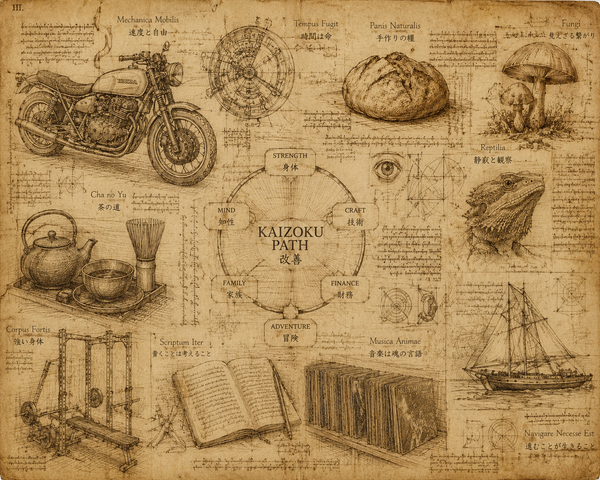
Kaizoku Path isn't about leaving your life behind. It's about discovering the adventure inside of it.
More Editions, Field Notes, and Project Ledgers can be found at kaizokupath.com