Modern Renaissance Man
A case for building a life that refuses false specialization. Mastery, curiosity, and presence create something deeper than productivity: a life that feels fully lived.
Edition IX:
The Specialist's World
Modern life tends to reward narrow competence, encouraging people to choose a single path, remain within it, and become increasingly efficient, optimized, and known for one clearly defined function. This approach makes sense from an economic standpoint, but it can feel spiritually empty. Over time, adulthood has come to resemble a quiet surrender of curiosity, where people stop learning things simply because those things make them feel alive, unless they also serve a professional purpose. That trade carries a real cost, because most individuals are not built to exist in only one dimension.
The modern renaissance mindset is not an attempt to become extraordinary. It is a refusal to become smaller than we were meant to be. It rejects the quiet belief that adulthood requires abandoning wonder in exchange for certainty or reducing identity to professional usefulness alone. A meaningful life is rarely discovered all at once. It is cultivated over years through practices, places, and pursuits that continually remind us there is more to explore. Not somewhere else, but here, within the life we already have.
Many of us are taught to believe that maturity requires reduction, as though the different parts of ourselves must eventually be narrowed into a single acceptable identity, profession, or socially recognizable form of usefulness. In reality, a full life rarely operates that way. Most people are not looking to eliminate parts of themselves, but to find a way for all of those parts to coexist with meaning. The goal is not to scatter attention across endless hobbies, but to create coherence among the things that make us feel most awake. This is the real work, which is not about becoming more efficient, but about becoming more integrated.
The Generalist's Instinct
My own career revealed this before I had the language to explain it. I built my professional identity through technical specialization, where deep knowledge creates trust and credibility. People rely on you when problems arise because you have developed expertise within a specific lane. That is how you gain access and earn a place in important conversations. Competence comes from focus, not from being casually interested in everything.
Over time, however, depth introduces a new kind of responsibility. As you advance, your role expands beyond your specialty, and you are expected to understand the systems connected to it, including sales, operations, customer psychology, maintenance, production realities, leadership, communication, and strategy. You are not required to master each of these areas, but you must understand them well enough to connect them meaningfully. At that point, growth begins to shift, because specialization opens the door, but integration is what allows you to move forward.
A Life of Many Threads
This same principle applies outside of work. A meaningful life often begins with a single craft or discipline, but it does not remain confined to it. Over time, that discipline teaches you how to build a broader world. Earlier eras understood this more intuitively. Leonardo da Vinci, for example, moved fluidly between art, engineering, anatomy, and design, allowing each discipline to inform and strengthen the others. Miyamoto Musashi approached mastery not just as technical skill, but as a philosophy that extended into writing, strategy, and art. Their significance did not come from the number of things they pursued, but from how those pursuits interacted and reinforced one another.
More recent examples carry the same pattern. Anthony Bourdain built a life rooted in curiosity, combining cooking, writing, travel, and observation into a cohesive way of seeing the world. Yvon Chouinard demonstrated that business could remain connected to personal values, blending craftsmanship, environmental awareness, and entrepreneurship into a unified philosophy. Robert M. Pirsig explored the idea that quality is not inherent in objects, but in the relationship between a person and their work, suggesting that care itself becomes a source of meaning. These lives differed in expression, but they were united by a shared principle of integration rather than confinement to a single path.
Integration
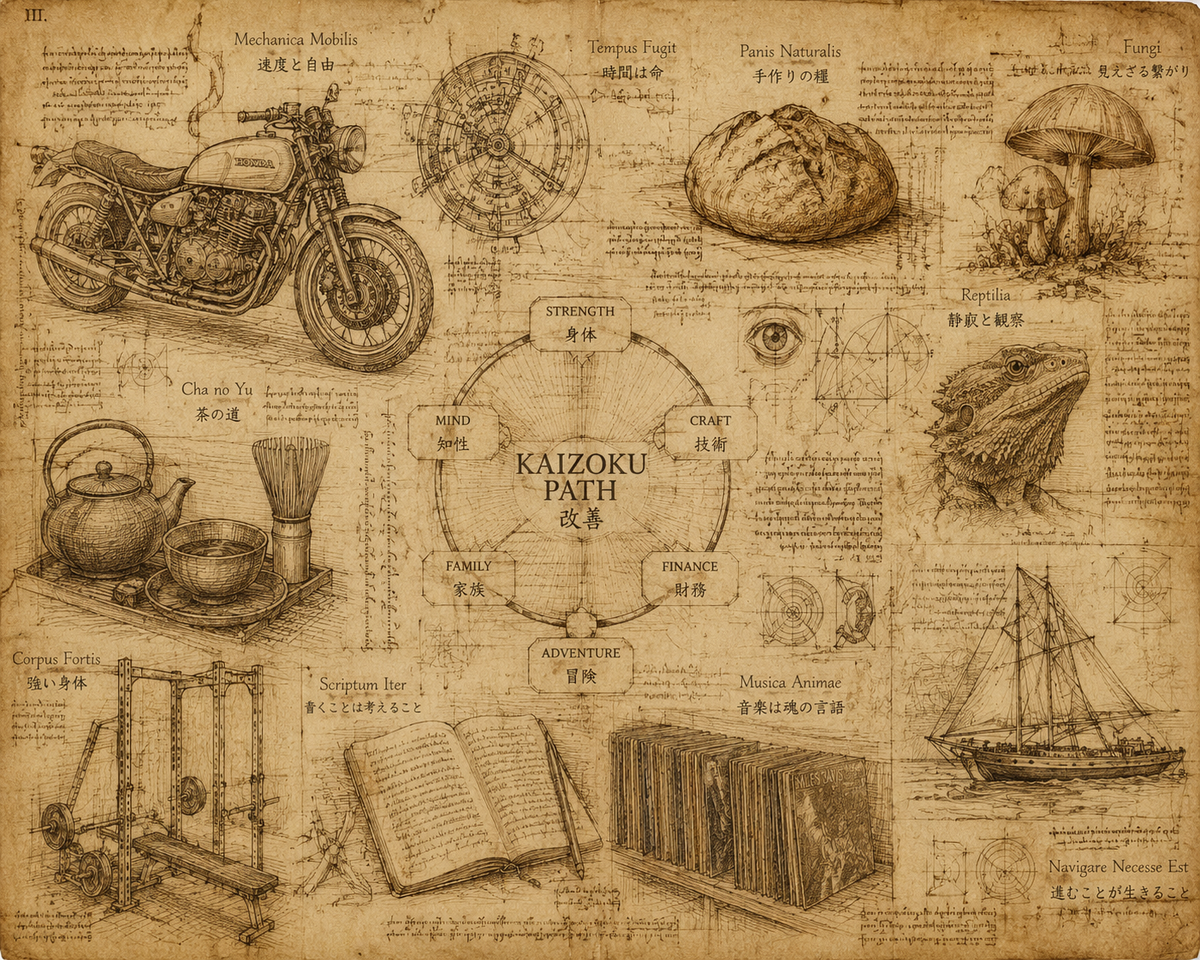
This reflects the deeper idea behind the so-called renaissance mindset, which is not about doing everything, but about building a life in which everything belongs. In my own experience, this has never taken the shape of one clean category. Tinkering with motors developed my mechanical intuition, bread taught patience, tea introduced ritual, reptiles built environmental awareness, music shaped rhythm and listening, writing refined clarity, fatherhood brought perspective, and business instilled responsibility. These pursuits are not separate; they inform and strengthen one another.
This is not distraction, but design. At the same time, there is a real risk of fragmentation. A life filled with many interests can easily become scattered, leaving behind unfinished projects, disconnected identities, and movement that feels like progress without becoming anything solid. Without an underlying philosophy, this kind of living can devolve into distraction disguised as self-expression. The critical question is not how many things you engage with, but what connects them.
For me, the connecting thread is presence, expressed through craftsmanship, attention, ownership, and the intention to build a life that feels genuinely lived rather than merely managed. This is where Kaizoku Path emerged, not as a brand, but as a response to the need for coherence, a framework where these different elements could exist together without contradiction. The goal was never to pursue everything aimlessly, but to create a world in which each part had a place.
This philosophy only holds value if it endures under real-life conditions. It is easy to speak about freedom when responsibilities are minimal, but much harder when there are children asleep upstairs, work waiting in the morning, bills to manage, and relationships that require energy and care. Many lifestyle philosophies fail because they are designed for escape rather than for reality. This approach is different, because it emphasizes meaning within the structure of everyday life.
Marriage becomes part of the practice, as does fatherhood and work. The small, consistent actions, such as building something in the basement, baking bread on a Saturday, writing late at night, or playing music between obligations, become expressions of the same path. This is not about leaving life behind, but about participating in it more fully.
The Modern Renaissance Individual
There is a growing hunger for this way of living. It appears in the renewed interest in slow living, home baking, martial arts, specialty coffee, vinyl records, custom motorcycles, homesteading, film photography, climbing, and the quiet rejection of constant optimization. People are not simply looking for more content; they are looking for texture, and evidence that life can still feel tangible and real.
This is why the idea of the modern renaissance individual is reemerging, not as a luxury, but as a corrective force. It does not require abandoning your job or pursuing a dramatic reinvention. It begins with something small that reminds you that you are alive, followed by another, and then by creating a space where those elements can connect. It might start with a single ritual, a project, a reclaimed corner of your home, or a discipline practiced long enough to become part of your identity.
This is how worlds are built, how ordinary life becomes something more meaningful, and how a sense of direction begins to take shape. The real act of resistance is not leaving everything behind but staying where you are and building something within it that is worth keeping, nurturing, and eventually passing on.